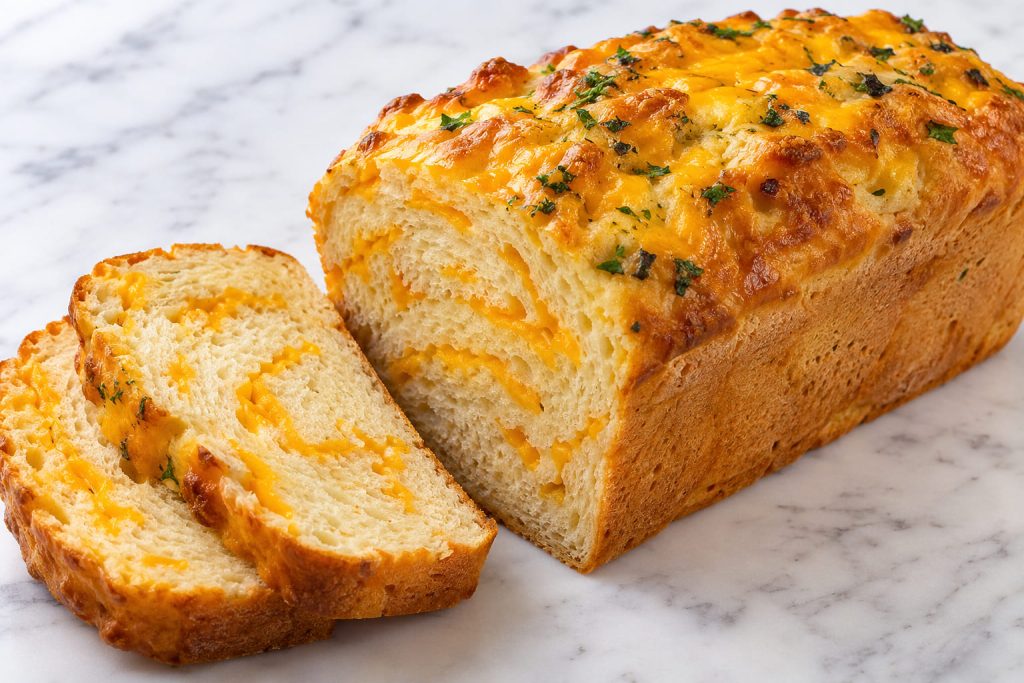
Prep Time: 30 minutesCook Time: 50 minutesTotal Time: 265 minutesYield: 10 slices (One complete 9-by-5-inch cheddar cheese loaf, cut crosswise into 10 approximately equal slices after cooling. One serving is one slice, including the end slices in the total count.)
Ingredients
3 cups Unbleached bread flour 390 g, spooned and leveled, room temp, up to 2 tbsp extra during kneading
2 cups Sharp yellow cheddar cheese 8 oz (226 g), freshly medium-grated, 68–72°F before shaping, divide 1 3/4 cups + 1/4 cup
1/2 cup Cultured buttermilk 120 ml, whole or low-fat, stir and warm to 105–110°F (41–43°C)
1/3 cup Water 80 ml, preferably filtered, warm to 105–110°F (41–43°C)
2 1/4 teaspoons Instant yeast 7 g, one standard packet, room temperature
2 tablespoons Granulated sugar 25 g
5 tablespoons Unsalted butter for the dough 71 g, melt completely and cool to 90–95°F (32–35°C)
1 large egg Large egg About 50 g without shell, bring to room temperature
1 teaspoon Fine sea salt 6 g, fine-grained table salt may be used
1/2 teaspoon Garlic powder for the dough About 1.7 g
1/2 teaspoon Neutral oil For lightly coating the first-rise bowl, nonstick cooking spray may be used instead
2 tablespoons Unsalted butter for the finishing glaze 28 g, melted and kept warm, About 100°F (38°C)
1/4 teaspoon Garlic powder for the finishing glaze About 0.8 g
1 as needed Nonstick baking spray Enough to coat the loaf pan thoroughly, softened butter may be used instead
Instructions
Warm the buttermilk and water separately to 105–110°F (41–43°C). Stir the buttermilk thoroughly before checking its temperature to eliminate hot spots. Pour both liquids into the stand-mixer bowl.
Whisk the sugar and instant yeast into the warm liquids. Leave undisturbed for 5 minutes. A light frothy film should appear on the surface.
Add the melted butter cooled to 90–95°F (32–35°C), room-temperature egg, salt, and dough portion of garlic powder. Add 1 cup (130 g) of the bread flour. Using the paddle attachment, mix on low speed for about 30 seconds until a wet batter forms. Stop and scrape the bowl.
Replace the paddle with the dough hook. Add the remaining 2 cups (260 g) bread flour and mix on low speed for 2 minutes, until the flour is incorporated and the dough looks rough and shaggy.
Knead with the dough hook at low-medium speed for 5 minutes. The dough should become smooth, elastic, supple, and slightly tacky. If it remains excessively stuck to the bowl after 3 minutes, add extra bread flour 1 teaspoon at a time, using no more than 2 tablespoons (18 g) extra in total. Avoid making the dough stiff or dry.
Lightly oil a large clean bowl. Turn the dough onto an unfloured surface and shape it into a smooth ball by rotating it against the counter to create gentle surface tension. Place it in the bowl, turn once to coat the top lightly, and cover.
Let the covered dough rise in a draft-free place at 75–80°F (24–27°C) for 60–75 minutes. Continue until approximately doubled in volume. An indentation made with two lightly floured fingers about 1/2 inch deep should remain rather than springing back immediately.
Coat the bottom, corners, and sides of the 9-by-5-inch loaf pan with nonstick baking spray. Gently press the risen dough to release excess gas, then transfer it to a very lightly floured work surface.
Roll the dough into an even 9-by-15-inch rectangle, keeping the 9-inch edge nearest you. Spread 1 3/4 cups (198 g) of the freshly grated cheddar evenly over the dough, leaving a 1/2-inch uncovered border on all four sides.
Starting at the near 9-inch edge, roll the dough tightly toward the far edge to form a cylinder approximately 9 inches long. Pinch the lengthwise seam firmly closed.
Cut the cylinder completely in half lengthwise, from end to end, exposing the cheddar layers. Rotate both halves so their cut surfaces face upward. Cross the strands at the midpoint and twist them over one another 2–3 times, keeping the exposed cheese layers facing up.
Pinch the two strands together at both ends and tuck the ends slightly underneath. Carefully lift the twisted loaf into the prepared pan, centering it without pulling the strands apart.
Loosely cover the pan with lightly oiled plastic wrap, keeping the wrap off the dough surface. Proof at 75–80°F (24–27°C) for 35–40 minutes. The twisted crest should rise to approximately 1 inch above the pan rim, and a gentle poke should spring back slowly and partially.
During the final 20 minutes of proofing, position an oven rack in the center-lower third and preheat the conventional oven to 350°F (177°C). In a small bowl, stir together the melted finishing butter, remaining garlic powder, and minced parsley. Keep the mixture ready for brushing.
Just before baking, gently dab half the garlic-parsley butter mixture over the exposed dough crests. Avoid pressing down on the risen dough. Sprinkle the reserved 1/4 cup (28 g) cheddar over the exposed crevices and top surface.
Place the pan on the center-lower oven rack and bake at 350°F (177°C) in conventional mode for 25 minutes. At the 25-minute mark, inspect the crust and place a loose dome of aluminum foil over the pan to protect the browning cheese from further direct heat.
Continue baking under the foil for another 20–25 minutes, for 45–50 minutes total. Starting at minute 45, insert an instant-read thermometer diagonally into the center of the bread crumb, avoiding melted cheese pockets. Remove the loaf when the crumb reaches 195–200°F (91–93°C). The crust should be deep golden with set, blistered cheese and no visible wet dough between the twists.
Remove the pan from the oven and set it on a wire rack. Immediately brush the remaining garlic-parsley butter mixture over the hot crust. Leave the loaf undisturbed in the pan for 10 minutes.
Carefully loosen any baked cheese sticking to the short ends or corners of the pan. Gently turn out the loaf and place it upright on the wire rack. If accessible, the bottom crust should sound hollow when lightly tapped.
Cool the loaf on the wire rack for at least 60 additional minutes before slicing. Use a long serrated bread knife and gentle sawing strokes to cut 10 approximately equal crosswise slices without compressing the crumb.
Notes
Timing: Allow 30 minutes of preparation, approximately 115 minutes of rising, up to 50 minutes of baking, and 70 minutes of cooling. Total planned elapsed time is 4 hours 25 minutes.
Flour: Use 3 cups (390 g) unbleached bread flour. Spoon and level when measuring by volume. Up to 2 additional tablespoons (18 g) may be added during kneading only if necessary, one teaspoon at a time.
Cheese: Freshly medium-grate 2 cups (226 g) sharp yellow cheddar from a block. Allow it to reach approximately 68–72°F (20–22°C) before shaping. Use 1 3/4 cups (198 g) inside the loaf and reserve 1/4 cup (28 g) for the top.
Dough readiness: After kneading, the dough should be smooth, elastic, and slightly tacky rather than stiff or heavily sticky.
First rise: Look for approximately doubled volume and a 1/2-inch finger indentation that remains.
Shaping: Roll to 9 by 15 inches, roll from the 9-inch edge, split the approximately 9-inch cylinder lengthwise, and keep the exposed cheddar layers facing upward during 2–3 twists.
Final proof: The crest should reach approximately 1 inch above the pan rim, and a gentle poke should spring back slowly and partially.
Baking: Use a conventional oven at 350°F (177°C). Tent loosely with foil after the 25-minute crust check. The primary doneness target is 195–200°F (91–93°C) in the center crumb, not in melted cheese.
Cooling: Rest for 10 minutes in the pan, followed by at least 60 minutes on a wire rack before slicing.
Storage: Cool completely, wrap securely, place in an airtight container, and refrigerate. Rewarm individual slices gently if desired.
Buttermilk substitution: Combine 1/2 cup (120 milliliters) whole dairy milk with 1/2 teaspoon (2.5 milliliters) fresh lemon juice. Rest for 5 minutes, then warm to 105–110°F (41–43°C). Expect a milder, less tangy flavor and potentially different dough behavior.
Parsley substitution: Use 1/2 teaspoon (approximately 0.5 g) dried parsley instead of 2 teaspoons fresh parsley for a gentler dried-herb flavor.
Pepper Jack variation: Substitute 8 ounces (226 g) freshly grated pepper Jack, using 7 ounces (198 g) inside and 1 ounce (28 g) on top.
Smoked-cheddar variation: Combine 4 ounces (113 g) regular sharp cheddar and 4 ounces (113 g) naturally smoked sharp cheddar, then divide between filling and topping.
Colby variation: Combine 4 ounces (113 g) sharp cheddar and 4 ounces (113 g) Colby, freshly grated, for a milder cheese flavor.
Jalapeño variation: Add 2 tablespoons (20 g) finely chopped pickled jalapeños, thoroughly drained and blotted dry, to the cheddar filling.
Black pepper variation: Add 1/2 teaspoon (1.5 g) freshly cracked coarse black pepper with the dough's garlic powder.
Convection oven: If the fan cannot be disabled, bake at 325°F (163°C), begin checking crust color at minute 20, tent as needed, and use the same 195–200°F (91–93°C) center-temperature target.