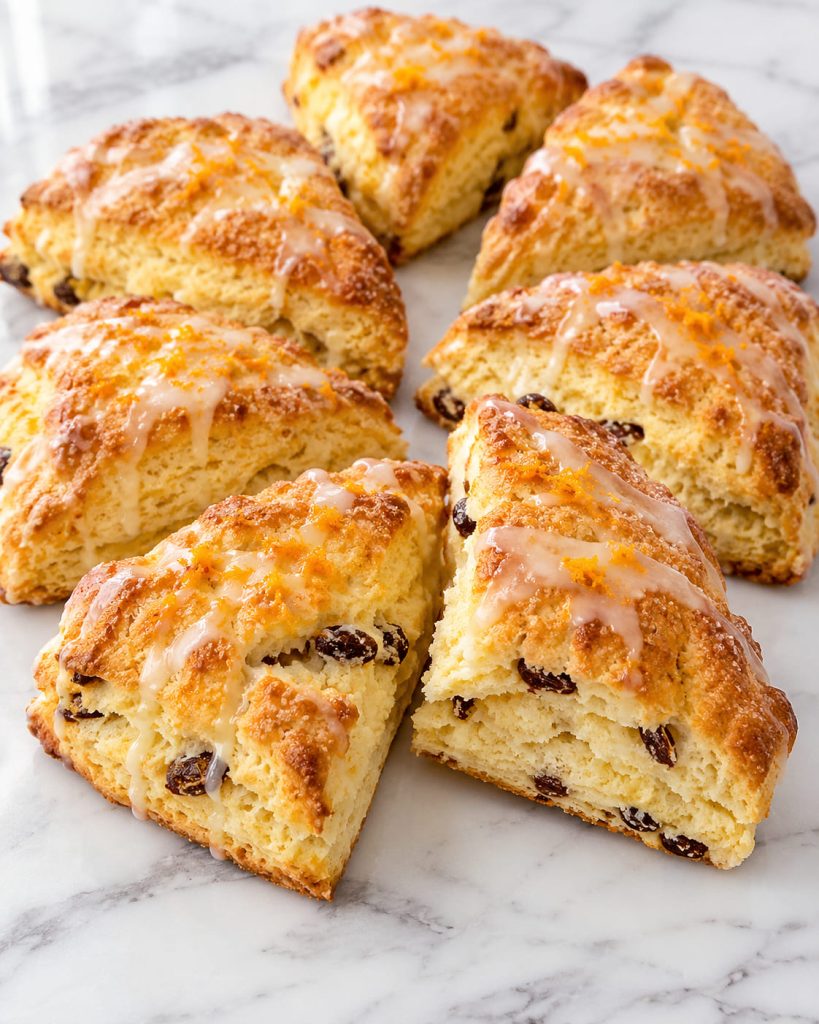
Prep Time: 15 minutesCook Time: 19 minutesTotal Time: 69 minutesYield: 8 large triangular scones (One serving is one large triangular wedge, cut from a single 8-inch-diameter dough disk divided into eight equal portions. The yield is eight glazed scones. Individual finished weights may vary; no exact serving weight is guaranteed.)
Ingredients
2 1/2 cups Unbleached all-purpose flour 300 g; spooned into the measuring cup and leveled; dry and at room temperature. Measure the full amount for the dough. A very light additional dusting of flour from the work surface is acceptable for shaping.
1/4 cup Granulated white sugar 50 g; dry and free of clumps; for the dough.
1 tablespoon Double-acting baking powder 14 g; fresh and lump-free.
1/2 teaspoon Baking soda 2.5 g; dry and lump-free.
1/2 teaspoon Fine sea salt 3 g; fine grind.
2 teaspoons Fresh orange zest 4 g; packed, finely grated from the bright orange outer peel only; avoid the bitter white pith. For the dough.
8 tablespoons Unsalted butter 113 g, equivalent to 1 US stick; frozen solid for at least 2 hours at 0°F (-18°C) or colder. Grate through the large holes of a box grater immediately before incorporation. Freezing is advance ingredient preparation and is not included in the 69-minute recipe timeline.
1/2 cup Cultured buttermilk 120 mL; well-shaken and refrigerator-cold, approximately 35–40°F (2–4°C); for the dough.
3 tablespoons Fresh orange juice 45 mL; freshly squeezed, strained to remove seeds and pulp, and refrigerator-cold; for the dough.
1 large egg Large chicken egg Approximately 50 g without the shell; refrigerator-cold; for the dough.
1/2 cup Seedless raisins 80 g; dark or golden raisins, dry and pliable, with sticky clusters separated. For folding into the dough.
1 large egg Large chicken egg Approximately 50 g without the shell; beaten thoroughly until uniform; reserved exclusively for the pre-bake egg wash.
1 teaspoon Cultured buttermilk 5 mL; for whisking into the pre-bake egg wash.
2 tablespoons Granulated white sugar 25 g; for sprinkling evenly over the egg-washed scone tops before baking.
1/2 cup Confectioners' sugar 60 g; sifted to remove lumps; for the orange glaze.
1 tablespoon Fresh orange juice 15 mL; freshly squeezed, strained, and at room temperature; for the orange glaze.
1 teaspoon Fresh orange zest 2 g; finely grated from the bright orange outer peel; for the orange glaze.
Instructions
Before starting the timed recipe, make sure the unsalted butter has been frozen solid for at least 2 hours at 0°F (-18°C) or colder. Keep it frozen until the moment it is grated. Have the dough buttermilk, orange juice, and egg cold. This advance freezing period is not included in the stated preparation or total time.
Position an oven rack in the center of the oven and preheat to 400°F (204°C) using conventional bake mode without a convection fan. Line a heavy 13-by-18-inch half-sheet pan with unbleached parchment paper. Allow the oven to reach its set temperature before baking.
In a large mixing bowl, combine the all-purpose flour, dough sugar, baking powder, baking soda, fine sea salt, and 2 teaspoons of fresh orange zest. Rub the zest into the dry mixture with clean fingertips for approximately 30 seconds to distribute the citrus oils. The mixture should look evenly combined, with no visible clumps of leavening.
Remove the frozen butter from the freezer and immediately grate it through the large holes of a box grater onto parchment. Transfer the shreds directly into the flour mixture. Toss gently with a fork or clean fingertips for 20–30 seconds, until the butter ribbons are separate and lightly coated with flour. Do not rub, mash, or smear the butter into a paste.
In a medium bowl, whisk together the 1/2 cup cold cultured buttermilk, 3 tablespoons cold orange juice, and the cold dough egg until the mixture is smooth and evenly blended.
Pour the liquid mixture into the butter-flour mixture all at once. Use a silicone spatula or fork to lift and fold the ingredients gently, approximately 15–20 strokes, until most of the dry flour is moistened and a loose, shaggy dough forms. Add the raisins and fold 3–4 more times to distribute them. Stop mixing before the dough becomes smooth or elastic.
Turn the shaggy dough onto a lightly floured work surface. Gently press the loose pieces together into a cohesive mass. If loose crumbs remain, fold the dough in half once and press lightly rather than kneading. Pat into one even round disk approximately 8 inches (20 cm) in diameter and 3/4–1 inch (2–2.5 cm) thick. Tuck any raisins exposed on the top surface gently beneath the dough to reduce scorching.
Lightly flour the straight edge of a metal bench scraper or long chef's knife. Cut straight down through the center of the dough disk without sawing or dragging the blade. Make the remaining radial cuts to divide the round into eight equal triangular wedges. Lift the blade cleanly between cuts.
Using the bench scraper, transfer the eight wedges to the prepared parchment-lined half-sheet pan. Arrange them in a staggered pattern with at least 2 inches (5 cm) of space between the wedges, including their pointed ends. Keep the cut sides exposed and avoid pressing the wedges back together.
In a small dish, whisk the separate finishing egg with 1 teaspoon cultured buttermilk until uniform. Lightly brush the tops of all eight wedges, keeping the wash off the cut sides. Sprinkle the 2 tablespoons granulated sugar evenly over the brushed tops. This forms the pre-bake sparkling sugar finish; the orange glaze is applied only after baking and cooling.
Place the pan on the center oven rack and bake at 400°F (204°C) in conventional mode for 18–20 minutes, with 19 minutes as the nominal recipe-card cook time. Rotate the baking sheet 180 degrees after 12 minutes. Begin checking at 18 minutes. The scones are ready when the tops and corners are deep golden-brown, the sides are pale-creamy with visible expansion fissures and feel firm, the bases are dry and golden, and a wooden toothpick inserted into the center of the thickest wedge comes out clean without raw batter. Use the physical doneness cues rather than the timer alone.
Remove the pan from the oven and leave the baked scones undisturbed on the warm baking sheet for 5 minutes. Then transfer them carefully with a spatula to a wire cooling rack. Allow another 20 minutes of cooling before applying the glaze. The scones should be at room temperature before glazing; if they remain warm, allow additional cooling time beyond the nominal estimate.
While the scones cool, whisk the sifted confectioners' sugar, 1 tablespoon room-temperature fresh orange juice, and 1 teaspoon finely grated orange zest in a small bowl until smooth, opaque, and free of dry sugar pockets. Prepare the glaze during the cooling period so this mixing time does not add a separate waiting period.
Once the scones have cooled, drizzle the orange glaze over their tops with a spoon or whisk. Leave the glazed scones undisturbed at room temperature for another 10 minutes, or until the glaze forms a set surface. This setting period follows the 5-minute pan rest and 20-minute rack cooling; it is not counted as concurrent with the pre-glaze cooling. Serve one glazed wedge per portion.
Notes
Freeze the unsalted butter for at least 2 hours at 0°F (-18°C) or colder before beginning. This advance freezing is excluded from the 69-minute total.
Frozen butter should remain in separate, lightly flour-coated ribbons after 20–30 seconds of gentle tossing.
Stop folding when the dough is rough and shaggy. Do not knead it smooth.
Shape one disk approximately 8 inches (20 cm) across and 3/4–1 inch (2–2.5 cm) thick. Cut eight wedges straight down and space them at least 2 inches (5 cm) apart.
Tuck exposed surface raisins beneath the dough to reduce scorching.
Keep the egg wash off the cut sides.
Check doneness using golden tops, set fissured sides, dry golden bases, and a clean toothpick.
Cool for 5 minutes on the pan and another 20 minutes on a rack before glazing. Allow approximately 10 additional minutes for the glaze to set.
Golden raisins or sultanas may replace dark raisins using the same 1/2-cup measure.
Dried Zante currants may replace raisins by the same 1/2-cup volume; their weight should not be assumed identical.
For a cultured-buttermilk alternative, add 1 1/2 teaspoons (7.5 mL) fresh lemon juice or strained orange juice to a measuring cup, then add whole milk to the 1/2-cup (120 mL) mark. Stir, stand for 5 minutes, and chill before use. Its thickness, flavor, and dough behavior may differ from cultured buttermilk.
For the approved unglazed afternoon-tea variation, omit the orange glaze and serve warm or at room temperature with clotted cream, orange marmalade, and hot black tea. Keep the dough, pre-bake finish, and baking instructions unchanged.