
These lemon blueberry biscuits bring together tender, flaky layers, juicy blueberries, fresh lemon flavor, and a sweet-tart glaze. Their lightly golden tops give way to a soft interior with distinct buttery layers and pockets of fruit. They’re lovely for breakfast, brunch, or an afternoon treat.

This is a rolled-and-cut style biscuit made by hand-patting the dough, not a scoop-and-drop biscuit or a butter-swim square. The dough is folded once and cut into 12 rounds. You won’t need a rolling pin or food processor. The recipe card contains the complete ingredients and instructions; the guidance below explains the important texture cues, why the ingredients work together, and what to do when something doesn’t look right.
Lemon Blueberry Biscuits
Tender, flaky lemon blueberry biscuits made with cold butter, cultured buttermilk, whole blueberries, and a fresh lemon glaze. The dough is gently hand-patted, folded once, and cut into 12 individual rounds.
Ingredients
- 2 cups all-purpose flour; use the remaining flour in the dough
- 2 tablespoons additional all-purpose flour (optional)
- 1/3 cup granulated white sugar 67 grams, at room temperature; rub with the lemon zest before adding the remaining dry ingredients
- 1 tablespoon fresh lemon zest About 6 grams, finely grated from the yellow outer peel only, avoiding the bitter white pith.
- 1 tablespoon baking powder 3 tsp or 12 grams; aluminum-free
- 1/4 teaspoon baking soda About 1.5 grams
- 1/2 teaspoon fine sea salt or table salt About 3 grams; for the biscuit dough
- 1/2 cup unsalted butter 1 stick or 113 grams; cut into 1/2-inch cubes and chill in the freezer for 15 minutes until very firm and cold
- 3/4 cup whole cultured buttermilk 180 ml, cold from the refrigerator
- 1 cup blueberries; 150 grams
- 1 cup confectioners' sugar 120 grams, sifted if lumpy; for the lemon glaze
- 2 tablespoons freshly squeezed lemon juice 30 ml, strained to remove seeds and large pieces of pulp; for the lemon glaze
- 1/2 teaspoon fresh lemon zest About 1 gram, finely grated yellow outer peel only; for the lemon glaze
- 1 pinch fine sea salt About 1/16 teaspoon; optional addition to the lemon glaze (optional)
Instructions
- Position an oven rack in the center and preheat the oven to 400°F (204°C) using conventional bake mode, without the convection fan. Line an 18-by-13-inch rimmed half-sheet baking pan with parchment paper. Cut the unsalted butter into 1/2-inch cubes, spread them on a small freezer-safe plate, and freeze for 15 minutes while preparing the remaining ingredients. Measure 2 cups of all-purpose flour, then remove 1 tablespoon into a small bowl to reserve for coating the blueberries. Keep the reserved flour separate from the remaining dough flour.
- While the butter chills, combine the granulated sugar and 1 tablespoon of finely grated fresh lemon zest in the large mixing bowl. Rub them together with your fingertips for approximately 30 seconds. The sugar should become pale yellow, slightly damp, and fragrant. This releases the lemon's aromatic oils into the sugar without adding extra liquid to the biscuit dough.
- Add the remaining 1 cup plus 15 tablespoons of measured flour, equivalent to the original 2 cups minus the reserved 1 tablespoon, to the lemon sugar. Add the baking powder, baking soda, and salt. Whisk for approximately 20 seconds to distribute the leavening ingredients evenly. Do not add the reserved tablespoon of flour to this bowl.
- Remove the butter cubes from the freezer and scatter them over the flour mixture. Use a pastry blender, two forks, or your fingertips to cut the butter into the dry ingredients. Stop when the mixture resembles coarse crumbs with visible pea-sized butter pieces and some flattened, almond-sized flakes. The butter should remain cold and distinct rather than becoming a smooth paste.
- Pour the cold cultured buttermilk around the flour-and-butter mixture. Fold gently with a flexible silicone spatula until shaggy clumps form and almost no loose dry flour remains at the bottom of the bowl. The dough should look rough, moist, and cohesive rather than smooth or pourable. Stop mixing as soon as this stage is reached; additional stirring can make the finished biscuits tougher.
- Place the completely dry fresh blueberries, or solidly frozen unthawed blueberries, into the small bowl containing the reserved 1 tablespoon of flour. Toss gently until the berries are lightly coated. Add the coated berries to the shaggy biscuit dough and fold with approximately 4 to 6 slow turns of the spatula. Stop once the berries are distributed through the dough. Avoid pressing or crushing them, which can release juice and discolor the dough.
- Lightly dust a clean work surface and your hands with the additional flour as needed. Turn out the dough and gently pat it into a rectangle approximately 3/4 inch thick. Fold the rectangle in half once to create light layers, then pat it to an even 1/2-inch thickness. Do not use a rolling pin. Dip a sharp-edged 2 1/2-inch round metal cutter in flour, press straight down without twisting, and lift straight up. Transfer each biscuit to the prepared pan. Gather the scraps gently once without kneading, pat them to 1/2-inch thickness, and cut the remaining rounds. Aim for 12 biscuits of similar size.
- Arrange the cut biscuits on the parchment-lined baking pan. For crisper, golden-brown sides, leave approximately 1 1/2 inches between biscuits. For softer, pull-apart sides and more vertical lift, arrange the rounds in a snug cluster with their edges barely touching. Refrigerate the entire pan for 10 minutes so the butter firms again and the dough rests. Keep the oven at 400°F (204°C) during this rest.
- Transfer the chilled pan directly to the center rack of the preheated conventional oven. Bake at 400°F (204°C) for 15 to 18 minutes, beginning the doneness checks at 15 minutes. Biscuits made with frozen blueberries may need an additional 1 to 2 minutes. Look for lightly golden crowns, visibly separated side layers, deeper golden bottom edges, and gently bubbling juice around any exposed blueberries. The tops should spring back lightly when pressed. Insert a toothpick into the center crumb away from a blueberry; it should come out clean or with a few dry crumbs, not wet batter. Continue baking briefly if the center remains underdone.
- Remove the pan from the oven and set it on a wire cooling rack. Allow the biscuits to cool for 5 minutes. Meanwhile, whisk the confectioners' sugar, freshly squeezed lemon juice, 1/2 teaspoon lemon zest, and optional pinch of salt in a small bowl until the glaze is smooth, thick but pourable, and falls from the spoon in a ribbon. Drizzle evenly over the biscuits while they are warm rather than piping hot. Allow approximately 5 additional minutes for the glaze to set before serving.
Notes
- Yield: 12 individual round glazed biscuits, approximately 2 1/2 inches wide; one biscuit per serving.
- Timing: 20 minutes preparation, 10 minutes pre-bake resting, 16 minutes baking, and 10 minutes cooling and glaze setting, for 56 minutes including the full finishing period.
- These are flaky hand-patted, folded, and cut biscuits, not scoop-and-drop biscuits or butter-swim biscuits.
- Flour accounting: the original 2 cups (240 g) supplies 1 cup plus 15 tablespoons (232 g) for the dough and 1 tablespoon (8 g) for coating the blueberries. Up to 2 tablespoons (16 g) of optional dusting flour is additional, not part of the original 2 cups.
- The approved recipe permits completely dry fresh blueberries or solidly frozen blueberries added without thawing. Coat either with the reserved measured flour. Frozen berries may require 1 to 2 additional minutes of baking; assess the center crumb rather than relying on time alone.
- For the approved buttermilk alternative, stir 2 teaspoons (10 ml) fresh lemon juice into 3/4 cup (180 ml) cold whole milk and let stand for 5 minutes. The biscuits may have slightly less rise and a milder tang than those made with cultured buttermilk.
- For a fruit variation, replace the blueberries with 1 cup (150 g) fresh blackberries, halved if very large, or 1 cup (150 g) firm fresh raspberries. Pat the fruit dry; raspberries may break more easily.
- For a crunchy sugar finish instead of glaze, brush the chilled biscuit tops with 1 tablespoon (15 ml) heavy cream or whole milk and sprinkle with 1 tablespoon (12 g) coarse turbinado or sanding sugar immediately before baking.
- The dry ingredients and lemon-rubbed sugar can be prepared in a covered bowl up to 1 day ahead. Keep butter, buttermilk, and blueberries separate until mixing.
- Cut unbaked rounds can be covered tightly and refrigerated on the parchment-lined pan for up to 12 hours. Uncover and bake directly from the refrigerator, allowing 1 to 2 additional minutes if needed.
- Specific tested storage and freezing durations for the finished glazed biscuits have not been established in the approved evidence.
Why These Lemon Blueberry Biscuits Have Flaky Layers
The texture begins with cold butter. Rather than disappearing completely into the flour, small pieces remain throughout the dough. During baking, the butter melts and releases moisture, helping create the delicate separation that makes a cut biscuit flaky instead of uniformly cake-like.
All-purpose flour provides enough structure for the rounds to hold their shape, while baking powder supplies much of the lift. Baking soda works with the acidity of cultured buttermilk. The buttermilk also brings moisture and a gentle tang that balances the sugar and berries. These ingredients work as a system, so changing the flour or liquid without an approved adjustment can change the rise and crumb.
Fresh lemon zest supplies fragrance without making the dough wetter. Rubbing it into granulated sugar helps release its aromatic oils. The lemon juice belongs in the glaze, where its brighter acidity can stand out against the buttery biscuit. This division gives the finished bake lemon flavor in both the crumb and topping without relying on lemon extract.
The single fold is equally important. It encourages layers without turning the dough into something that needs repeated kneading. For this recipe, a slightly rustic, tender biscuit is the goal—not a perfectly smooth dough or a tightly worked pastry.
Two Texture Checkpoints Worth Seeing
Checkpoint one: the butter and flour mixture. Before the buttermilk goes in, the mixture should resemble coarse crumbs with visible pea-sized pieces of butter and some flattened flakes. Those irregular pieces are intentional. A uniformly smooth paste means the butter has become too thoroughly incorporated, making distinct flaky layers harder to achieve.
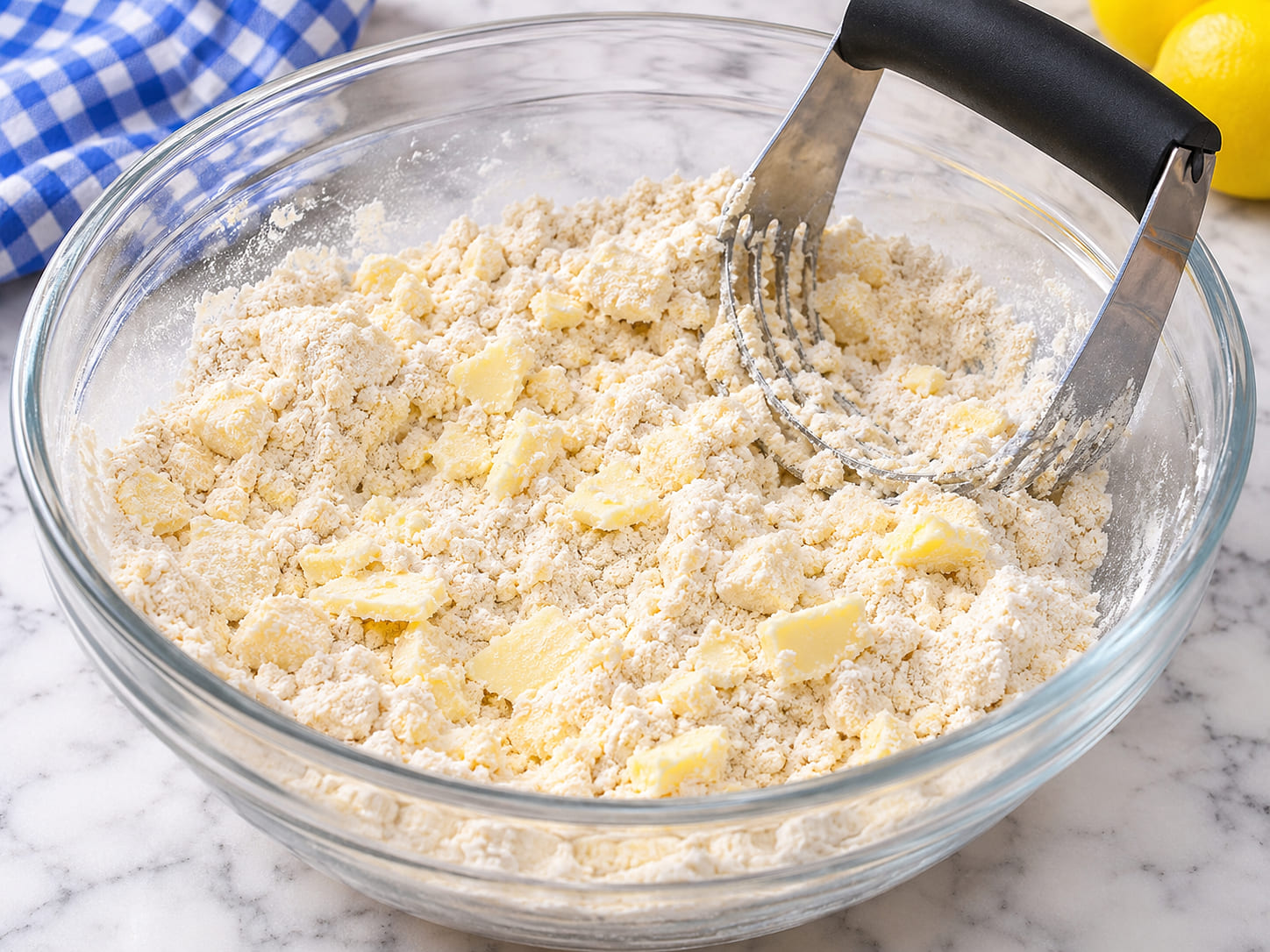
Checkpoint two: the shaped dough. Once moistened, the dough should look shaggy and feel cohesive enough to hold together when gently patted. A few rough edges are fine. It shouldn’t pour, spread like batter, or require prolonged kneading to become perfectly smooth.
The blueberries should remain mostly whole, with only occasional purple streaks. Their coating flour is reserved from the recipe’s measured flour rather than added on top of it. This matters because extra flour introduced during fruit preparation can make the finished biscuits unnecessarily dry.
The cut rounds should have recognizable, straight edges and enough structure to stand on the baking sheet without collapsing. The photograph below shows the intended unbaked shape.
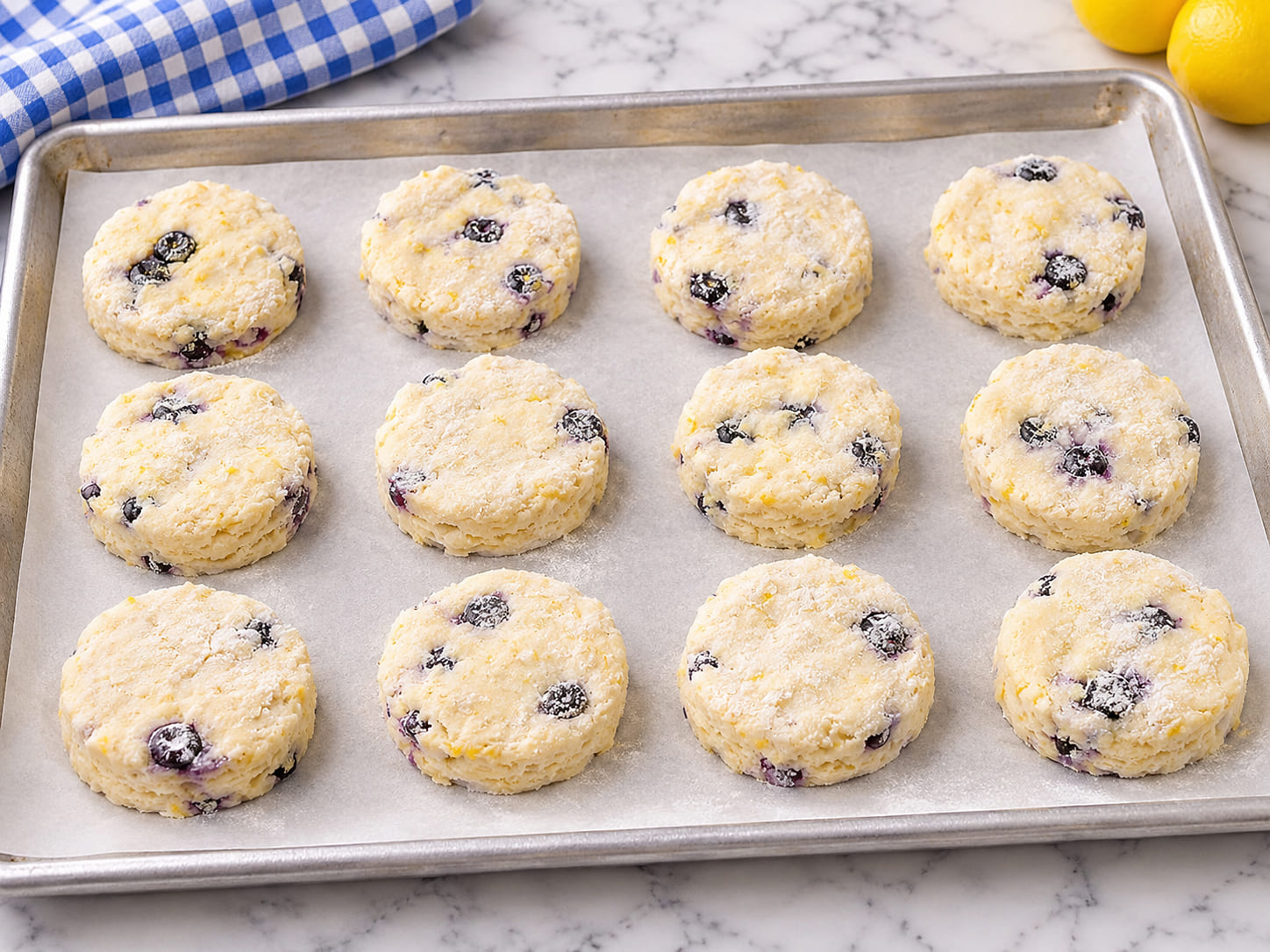
If you’re comparing this technique with other biscuit styles, our easy biscuit recipe guide provides a useful starting point. The important distinction here is that this dough is shaped and cut, not dropped by the spoonful.
Why Gentle Shaping Matters
Blueberries make biscuit dough more delicate than a plain buttermilk version. Pressing hard against the fruit can burst the skins, release juice, and create wet purple patches. Hand-patting gives you more control than repeatedly rolling across the berries.
Cold butter also needs protection during shaping. If the dough becomes warm and greasy, the butter pieces can smear into the flour instead of remaining separate. The approved chilling period before baking helps the shaped rounds enter the oven with their structure intact.
Pay attention to the cutter, too. A straight downward cut leaves the sides open for expansion. Twisting compresses the edges and can interfere with upward rise. Gather scraps only once rather than repeatedly working them into a smooth ball. Later-cut biscuits may look less uniform, but preserving tenderness matters more than perfect symmetry.
The spacing on the baking sheet affects the finished sides. Rounds placed apart develop more exposed, crisp edges, while biscuits positioned barely touching tend toward softer sides and a taller appearance. Both arrangements are approved; choose according to the texture you prefer.
How to Recognize a Fully Baked Center
Blueberries complicate the usual visual test because their juice can make a fully baked biscuit look moist. A golden crown alone isn’t enough to establish doneness, especially when the interior contains fruit pockets.
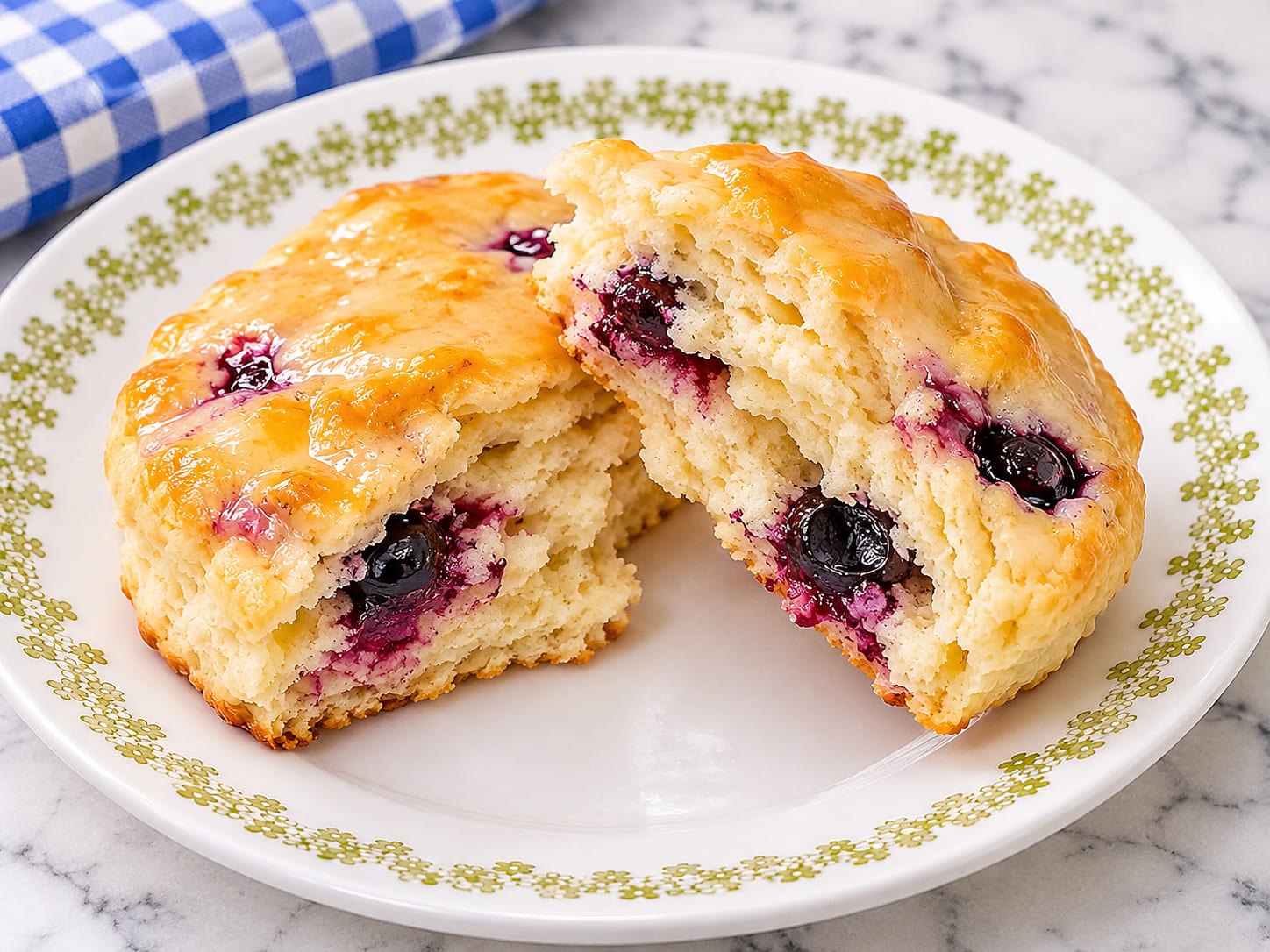
Look at the whole biscuit: the bottom edges should be golden, the sides should show separation between layers, and the crumb should have enough structure to spring back gently. A little bubbling blueberry juice is expected. What you don’t want is pale, sticky, floury dough immediately surrounding the berries.
When checking with a toothpick, choose a section of crumb away from a blueberry pocket. Berry juice on the toothpick can be misleading; wet dough is the important warning sign. If the exterior has browned but the center remains underbaked, allow a little more baking time rather than raising the oven temperature.
The split biscuit below illustrates the desired contrast: a tender, fully baked interior with distinct blueberry pockets beneath the lemon glaze. The crumb should look soft and layered, not gummy or compressed.
Troubleshooting Texture and Rise
Dense or tough biscuits: Excess mixing after the buttermilk is added can develop too much structure. Repeated kneading or reshaping has a similar effect. The useful correction is to stop working the dough as soon as it becomes cohesive enough to shape. A rough surface isn’t a defect.
Flat biscuits or poor rise: Butter that softens excessively can compromise the layers, while twisted cutter edges can restrict expansion. Also consider whether the baking powder is active. Preserve the cold-butter pieces, the clean cut edges, and the chilled rest specified in the recipe card.
Excessively purple dough: Berry juice spreads when fruit is crushed or thawed before incorporation. Completely dry fresh berries are easier to handle, while approved frozen blueberries should remain solidly frozen. A little color is natural; the aim is to avoid unnecessary crushing, not to eliminate every streak.
Dry or crumbly results: Adding too much flour during shaping can disturb the approved balance. Use only the limited additional dusting flour permitted in the recipe, and remember that the tablespoon reserved for coating the berries is already part of the measured flour quantity.
A Lemon Glaze That Coats Instead of Running Off
The glaze should be thick enough to cling to the biscuit’s uneven surface but fluid enough to drizzle. Think of a smooth ribbon falling from the spoon, rather than a watery stream or a stiff paste.
Whisk thoroughly before deciding that the consistency needs correction. Unincorporated confectioners’ sugar can make a glaze appear uneven even when the measured proportions are right. The approved brief cooling period matters because a piping-hot biscuit can cause the glaze to run off before it settles.
Once drizzled, the topping needs a short setting period. That pause helps preserve a visible lemon coating while leaving the biscuit pleasantly warm. Avoid changing the approved glaze balance with arbitrary additions of sugar or liquid.
Approved Variations and Make-Ahead Choices
Fresh or frozen blueberries: Both are approved. Fresh berries should be thoroughly dry, while frozen berries go into the dough without thawing. Frozen fruit may extend baking by approximately 1 to 2 minutes, so judge the finished crumb rather than assuming both versions will be ready at precisely the same moment.
Other berries: Fresh blackberries or firm fresh raspberries can replace the blueberries in the approved quantity. Large blackberries should be halved. Raspberries are more fragile, so expect a greater chance of streaking when shaping the dough.
Buttermilk alternative: Cold whole milk acidified with fresh lemon juice is an approved substitute. Follow the recipe notes for its exact proportions and resting time. It may produce a slightly milder tang and less rise than cultured buttermilk. Almond, oat, and coconut flours have not been established as direct one-for-one replacements for the all-purpose flour.
Different finish: If you’d rather have a crisp sugar-topped biscuit than a lemon glaze, the approved cream-or-milk wash with coarse sugar is applied before baking. It changes the topping without changing the underlying dough.
Preparing ahead: The dry mixture and lemon-rubbed sugar can be prepared up to one day in advance, with the wet ingredients and fruit kept separate. Alternatively, shaped rounds may be covered and refrigerated on their prepared pan for up to 12 hours, then baked directly from cold with the approved timing adjustment.
Leftovers and reheating: The evidence does not establish verified storage, freezing, or reheating durations for finished glazed biscuits. Rather than promise a particular shelf life or reheating result, treat those details as unverified for this formula. For the intended fresh-baked texture, the approved method and glaze timing remain the reliable reference.
Frequently Asked Questions
Are lemon blueberry biscuits drop biscuits or cut biscuits?
This recipe makes cut biscuits, not drop biscuits or butter-swim squares. The soft, shaggy dough is gently patted, folded once, and cut with a sharp-edged 2½-inch round cutter. It should hold together for shaping rather than flow or scoop like batter. Cold butter and gentle handling help create tender, flaky layers.
How can I tell whether the centers are fully baked?
Look for lightly golden crowns, deeper golden bottom edges, visibly separated side layers, and tops that spring back gently. Bubbling blueberry juice is normal, but pale, sticky dough around the berries indicates underbaking. Insert a toothpick into the center crumb away from a blueberry pocket; it should come out clean or with a few dry crumbs. If wet dough remains, continue baking briefly.
Why did my blueberries turn the biscuit dough purple?
Purple streaks develop when blueberries are crushed or release juice during mixing and shaping. Both fresh blueberries and solidly frozen blueberries are approved for this recipe. Rinse fresh berries and pat them completely dry, or use frozen berries directly from the freezer without thawing. Gently coat either option with the 1 tablespoon of flour reserved from the recipe's measured 2 cups, then fold into the shaggy dough without crushing the fruit. Pat the dough by hand instead of using a rolling pin. Biscuits made with frozen blueberries may need an additional 1 to 2 minutes of baking.
Why does the lemon glaze run off the biscuits?
The biscuits may be too hot when glazed, or the glaze may be too thin. Let the baked biscuits cool for 5 minutes before drizzling. The glaze should be smooth, thick but pourable, and fall from a spoon in a ribbon rather than run like water. Whisk the measured ingredients thoroughly before judging consistency, and allow approximately 5 additional minutes for the glaze to set.
More Biscuit Recipes to Explore
For another opportunity to practice cold-butter handling without blueberries or glaze, try our buttermilk biscuits recipe. If you enjoy fruit-and-citrus breakfast baking but want a different texture, explore orange raisin scones. For a softer, sweeter biscuit style, our soft condensed milk biscuits offer another direction.
Save This Recipe
Enter your email below and we'll send the link straight to your inbox. You'll also get fresh baking recipes each week.
More From Biscuits & Breads

You Might Also Like



This is such an important and often overlooked topic Thank you for bringing attention to it and offering valuable advice